
Speech Delay in Children: When Is It Normal and When Does Your Child Need a Professional Evaluation?
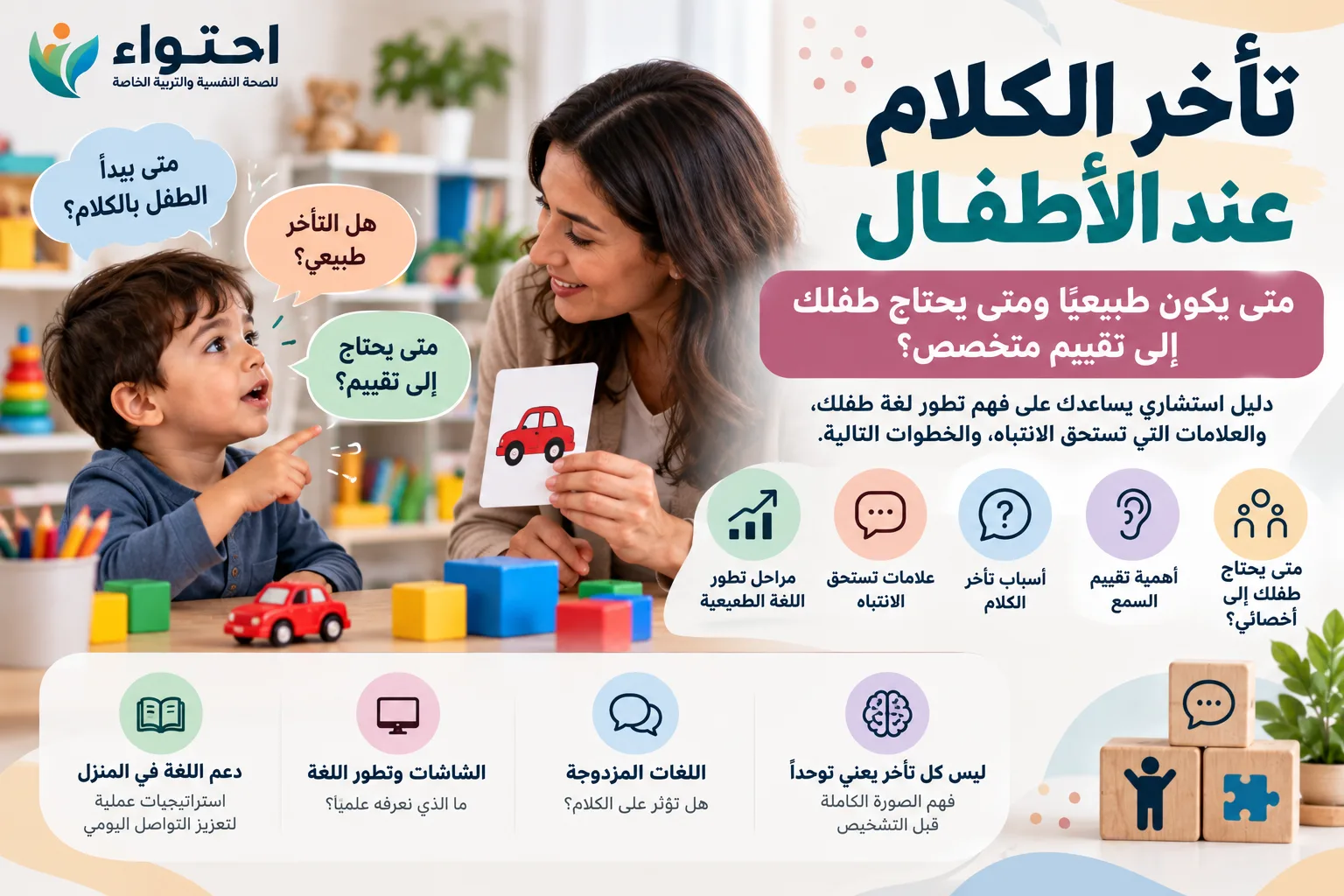
Prepared by: Dr. Ahmed Mohamed Abdel Wahab
Consultant in Mental Health, Special Education, and Family Counseling
“My son is two years old and does not speak like other children his age. Should I wait?”
“He understands everything, but he does not talk very much.”
“I was told that boys often speak later and that he will eventually start talking on his own.”
These are statements I frequently hear from parents, and they reflect one of the most important questions during the early years of a child’s life:
When is delayed speech simply an individual variation in development, and when is it a sign that warrants professional evaluation?
From a professional perspective, speech delay should not be approached from either of two extremes: becoming overly concerned about every minor developmental difference, or waiting for years in the hope that the difficulty will resolve spontaneously.
A more appropriate approach is to consider the child’s overall developmental profile.
Language development is about much more than the number of words a child can say.
Speech and Language Are Not the Same
Before discussing developmental delay, it is important to distinguish between speech and language.
Speech refers primarily to the production and articulation of sounds and spoken words.
Language is broader. It includes understanding what other people say, using words and sentences to express needs, ideas, and experiences, and communicating and interacting meaningfully with others.
For example, one child may be able to pronounce many words but have difficulty using them functionally for communication.
Another child may understand instructions well and interact socially in an appropriate way but have a limited spoken vocabulary.
These two children may require different types of assessment and intervention.
Therefore, it is not enough to ask:
“Can the child talk?”
We should also ask:
“How does the child understand language? How does the child express themselves? And how does the child communicate?”
When Do Children Begin to Talk?
Language development occurs gradually, and there is natural variation among children in the age at which specific skills emerge.
In developmental assessment, however, we look for the progressive emergence of communication and language abilities, including responding to sounds and people, babbling, using gestures, understanding words and simple instructions, producing words, combining words, and gradually developing more complex sentences.
A single age threshold or a specific number of words should not be used in isolation to determine whether a child has a developmental difficulty.
A more meaningful question is:
Is the child making consistent progress in communication and language skills in a way that is broadly appropriate for their developmental stage?
“My Child Does Not Talk, but Understands Everything”
This is a very important statement.
A child’s understanding of language is an important part of assessment, but good comprehension does not mean that a delay in expressive language should automatically be ignored.
When a parent tells me that their child “understands everything,” I need to clarify exactly what that means.
Does the child understand instructions without relying on gestures?
Can the child identify familiar objects by name?
Can the child follow simple instructions and, when developmentally appropriate, more complex instructions?
Does the child understand questions?
Can the child select a requested object from several alternatives?
Sometimes, we discover that a child relies on context, familiar routines, and visual cues more heavily than the family initially realizes.
Parental observations are extremely valuable, but they may sometimes need to be supplemented by a more structured professional assessment.
Signs That Deserve Attention
Assessment should never be based on a single sign. However, certain developmental indicators should not be overlooked.
These may include reduced response to name, limited use of gestures for communication, a spoken vocabulary that appears limited relative to developmental expectations, difficulty understanding age-appropriate instructions, little or no progression in language skills over time, or marked difficulty using language for expression and social communication.
One sign, however, deserves particular attention:
The loss of a skill the child had previously acquired.
If a child was previously using words or communication skills and then loses those abilities, this warrants professional evaluation without unnecessary delay.
Speech Delay Is Not a Diagnosis in Itself
This is a fundamental point.
When we say that a child has “delayed speech,” we are describing an observation. We have not yet identified the underlying cause.
Speech and language difficulties may be associated with a range of factors, including hearing difficulties, developmental language disorders, speech sound difficulties, certain neurodevelopmental conditions, global developmental delay, or other factors that require appropriate assessment.
Therefore, the most useful question is not simply:
“How can I make my child talk?”
A better question is:
“Why are my child’s communication and language abilities not developing as expected?”
Understanding the nature and possible causes of the difficulty helps professionals determine the most appropriate form of intervention.
Does Speech Delay Mean Autism?
No.
Speech delay alone does not mean that a child has Autism Spectrum Disorder.
This is an important point because the possibility of autism can cause considerable anxiety for families.
When Autism Spectrum Disorder is suspected, professionals do not consider the number of spoken words alone.
They also examine patterns of social communication and interaction, behavior and interests, as well as the child’s developmental history.
For example, we may ask:
How does the child use eye contact as part of communication?
Does the child share interests and experiences with others?
Does the child use pointing and other gestures to communicate?
How does the child interact with children and adults?
Are there restricted or repetitive patterns of behavior or interests?
How have these abilities developed since early childhood?
Therefore, a child should not be assumed to have autism simply because speech is delayed.
At the same time, the need for a broader developmental assessment should not be dismissed when other developmental signs are present alongside the language delay.
Do Screens Cause Speech Delay?
This is another frequently asked question.
Excessive screen use may reduce opportunities for direct interaction, play, conversational turn-taking, and responsive communication between a child and caregivers—all of which are important experiences for language development.
However, it is also inappropriate to attribute every language delay to smartphones, tablets, or television.
If a child has a significant delay, it is not sufficient simply to say:
“Take away the phone and the child will start talking.”
Reducing inappropriate or excessive screen exposure may be part of improving the child’s communication environment, but it does not replace professional assessment when developmental concerns are present.
What About Children Growing Up With Two Languages?
Exposure to two languages does not automatically cause a language disorder.
Families should not be advised indiscriminately to stop using their primary home language simply because they are concerned about language development.
If there is a genuine concern about a child’s language development, their abilities should be evaluated in the context of the languages to which they are exposed and how those languages are used in everyday life.
It is not appropriate to assume that “two languages are the cause” without proper assessment.
Why Is Hearing Assessment Important?
Hearing should always be considered when evaluating speech and language development.
Children require adequate access to spoken language in their environment for speech and language abilities to develop effectively.
Hearing difficulties may not always be obvious to families.
A child may respond to certain sounds or to television and still require a formal hearing assessment when clinically indicated.
For this reason, hearing evaluation may form an important part of the overall assessment plan, depending on the child’s presentation and professional recommendations.
What Happens During a Professional Assessment?
A high-quality assessment does not begin simply by asking the child to repeat a list of words.
It begins by understanding the child.
Professionals may need to explore the child’s developmental history, when communication skills emerged, how the child understands language, how they express needs and ideas, how they interact socially, the nature of their play and behavior, and, where appropriate, other cognitive and developmental abilities.
Depending on the child’s individual needs, assessment may involve a:
- Speech and language professional.
- Developmental or special education professional.
- Hearing assessment.
- Medical or broader developmental evaluation.
In some cases, a multidisciplinary team approach may be the most appropriate option.
Why I Do Not Recommend a Simple “Wait and See” Approach
Because waiting is not an intervention plan.
It is true that some children may make significant developmental progress over time. However, we cannot assume that this will happen for every child without considering the broader developmental picture.
If there is an underlying reason for the delay, allowing time to pass without assessment may mean missing an important period during which the child and family could have received appropriate support.
For this reason, I prefer a simple principle:
When there is a genuine developmental concern, assess first and then decide.
The assessment may conclude that the child simply needs monitoring and guidance for the family.
Alternatively, it may identify a need for specialized intervention.
In either case, the family will be making decisions based on information rather than prolonged uncertainty and worry.
What Can Families Do at Home?
Everyday communication with the child is extremely valuable.
Talk to your child during natural daily activities rather than turning the home into a continuous testing environment.
If the child is holding a toy car, for example, you might say:
“Car.”
“Red car.”
“The car is moving.”
If the child points to water, provide a simple language model:
“Water.”
“I want water.”
Read picture books together, name objects naturally, pause to give the child opportunities to initiate communication, join the child in play, and respond positively to communication attempts even when spoken words are incomplete.
One common mistake is spending much of the day repeatedly testing the child:
“What is this?”
“Say apple.”
“What is this?”
“Say car.”
Language does not develop through constant testing alone.
It also develops through interaction, play, shared experiences, responsive communication, and meaningful engagement.
Do Not Compare Your Child With Siblings or Relatives
“His sister was already talking when she was one.”
“His cousin is the same age and speaks in complete sentences.”
Such comparisons can increase parental anxiety without providing a scientifically meaningful assessment.
We do not evaluate a child by comparing them with one sibling, cousin, or neighbor.
Instead, we consider the expected developmental trajectory, individual variation, and the child’s overall profile of abilities.
Most importantly, we monitor the child’s own progress.
Are their skills developing?
Are they acquiring new words?
Is their understanding improving?
Are they communicating more effectively?
These questions are more informative than comparisons with another child.
When Should Families Seek an Evaluation?
When parents notice that the development of communication, language comprehension, or expressive language does not appear to be progressing as expected—or when there are additional concerns involving social interaction or general development, or a loss of previously acquired skills—it is advisable to discuss these concerns with an appropriately qualified professional.
I do not recommend beginning by searching for a specific diagnosis.
Instead, begin with these questions:
What is my child’s current developmental level? What are their strengths? Which skills require additional support? And what should the next step be?
These questions are far more useful than attempting to identify a diagnostic label before an appropriate assessment has taken place.
A Message to Every Parent
From my professional experience in mental health, special education, and family counseling, I believe that the most appropriate approach to speech delay can be summarized in one simple principle:
Do not panic—and do not ignore it.
Do not assume the worst simply because your child developed speech later than another child.
At the same time, do not postpone an assessment for years because someone tells you:
“The child will grow up and start talking on their own.”
Early intervention does not necessarily mean that a child has a serious disorder.
It means that we take the child’s development seriously and provide appropriate support at the appropriate time.
And always remember:
Our goal is not simply to help a child produce words. Our goal is to help the child understand, express themselves, communicate, and share their world with others.
If you have concerns about your child’s speech or language development, an initial consultation and developmental assessment can be an appropriate starting point for identifying the child’s current abilities and determining whether monitoring, further specialized assessment, or an individualized intervention program may be needed.
Prepared by:
Dr. Ahmed Mohamed Abdel Wahab
Consultant in Mental Health, Special Education, and Family Counseling
Professional Disclaimer
This article is intended for educational and awareness purposes only. It does not constitute an individual diagnosis and should not be considered a substitute for direct assessment by appropriately qualified professionals.