Dr. Ahmed Mohamed Abdel Wahab explains: Tantrums in children.. Their causes and ways of dealing with them and when do you need specialized intervention?

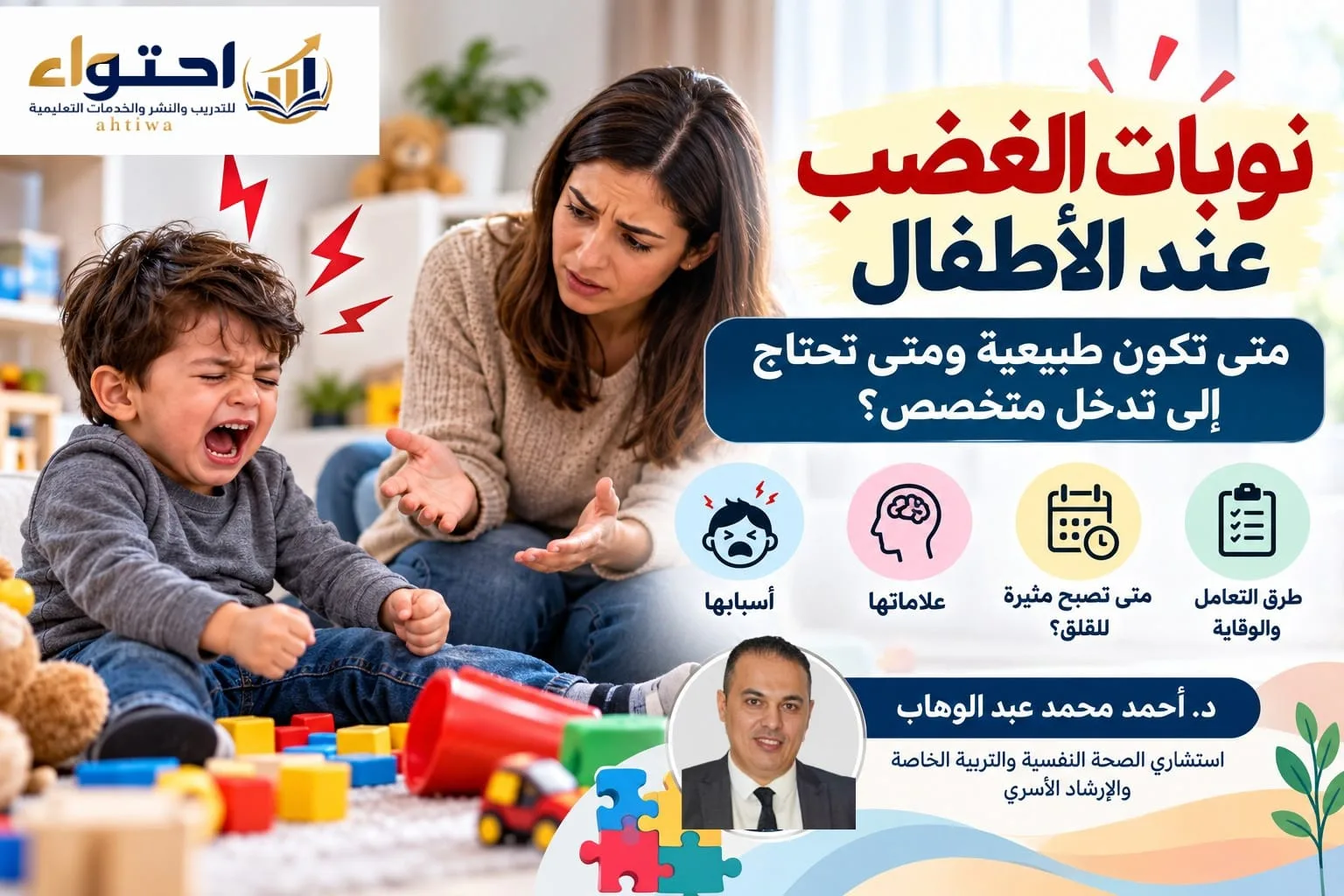
Temper Tantrums in Children: Causes, How to Manage Them, and When to Seek Professional Help
Prepared by: Dr. Ahmed Mohamed Abdel Wahab
Consultant in Mental Health, Special Education, and Family Counseling
Ehtiwaa Platform for Training, Mental Health, and Special Education
Temper tantrums in children are among the most common concerns that lead parents to seek advice about behavioral modification and parenting.
A child may start screaming, crying intensely, throwing themselves on the floor, or throwing objects. In some cases, the behavior may escalate to hitting or kicking.
This raises a recurring question:
Are my child's tantrums normal, or do they indicate a behavioral or psychological problem that requires professional intervention?
From a professional perspective, this question cannot be answered simply by describing a child as “nervous” or “stubborn.”
In child behavior modification, the goal is not merely to stop disruptive behavior. Instead, we first try to understand:
Why does the behavior occur, and what is the child trying to achieve through it?
This is the right starting point for understanding and managing temper tantrums.
What Are Temper Tantrums in Children?
A temper tantrum is an emotional and behavioral response that may occur when a child feels frustrated, is denied something they want, struggles to express their needs, or cannot regulate their emotions in a particular situation.
Temper tantrums may appear in the following forms:
- Screaming and intense crying.
- Throwing themselves on the floor.
- Refusing to follow instructions.
- Throwing objects.
- Hitting or kicking.
- Attempting to hurt others in some cases.
The presence of temper tantrums does not automatically mean that a child has a psychological or behavioral disorder.
Children, particularly during their early developmental years, are still learning emotional regulation, how to express their needs, and how to cope with rejection and frustration.
However, when tantrums become severe or frequent, or begin to affect the child's life and family, they need to be assessed more carefully.
What Causes Temper Tantrums in Children?
There is no single cause that applies to every child.
A tantrum may occur because a child wants a toy or a phone.
It may happen because the child wants to avoid homework or a difficult activity.
The child may also struggle to express what they want verbally.
Tantrums may be associated with hunger, fatigue, disruptions to routine, or exposure to excessive sensory stimulation.
In some children, tantrums may be more complex due to difficulties with communication, emotional regulation, or certain developmental disorders.
Therefore, the right question is not:
“Why is my child stubborn?”
Instead, we should ask:
“What is causing this behavior to occur in this particular situation?”
Behavioral Analysis: What Happens Before and After a Tantrum?
One of the most important principles of behavior modification in children is observing what happens before a behavior and what happens afterward.
Consider a simple example:
A child asks for a phone.
The mother refuses.
The child starts screaming and crying.
The tantrum continues for several minutes.
The mother becomes exhausted and gives the child the phone to make the crying stop.
In this situation, the child may gradually learn:
Screaming for long enough = getting the phone.
As a result, the behavior may be unintentionally reinforced.
This is an important point because some parents focus only on what the child did, while the key to understanding why the problem continues may lie in the outcome the child receives after the behavior.
What Is Meant by the Function of Behavior?
In behavioral analysis, we try to identify the function of a behavior rather than simply describing it as bad behavior.
A child may use a tantrum to:
- Obtain something they want.
- Escape a task or activity.
- Gain attention.
- Express communication difficulties or problems with emotional regulation.
- Respond to certain sensory factors.
However, the function of a behavior should not be determined based on a single incident.
Repeated observation and information gathering are necessary before developing a behavior modification plan.
Are Temper Tantrums Caused by Spoiling a Child?
Not necessarily.
This is one of the most common misconceptions that needs to be corrected.
It is true that a family's response to a tantrum may sometimes contribute to its continuation. However, temper tantrums in children have multiple possible causes.
They may be associated with communication difficulties, an inability to tolerate frustration, changes in routine, or certain psychological, developmental, and environmental factors.
Therefore, describing a child as “spoiled” does not provide a scientific explanation for the behavior or help us address it.
What Is the Difference Between a Temper Tantrum and a Meltdown Caused by Overstimulation?
Not every intense episode is an attempt by a child to obtain something they want.
Some children may experience overwhelming fatigue or overstimulation due to noise, crowded environments, sudden changes, excessive demands, or certain sensory stimuli.
In such situations, the child may temporarily be unable to regulate themselves.
Treating the child as if they are deliberately being stubborn may make the situation worse.
The priority is to maintain safety, reduce stimuli as much as possible, help the child regain their composure, and then examine the circumstances that led to the episode.
When Are Temper Tantrums in Children a Cause for Concern?
The occurrence of a tantrum alone is not enough to determine whether there is a problem.
When assessing temper tantrums, I generally consider five important factors:
Age – Frequency – Duration – Intensity – Impact on Daily Life.
Professional assessment becomes more important when tantrums are unusually severe or frequent, involve significant aggression or self-injury or harm to others, or affect school, relationships, and family life.
It is also important to pay attention when a family continually changes its activities and daily routines out of fear that another tantrum might occur.
Speech Delay and Temper Tantrums in Children
There may be a connection between speech delay and temper tantrums in some children.
Imagine a child who knows what they want but cannot express it.
Or a child who does not understand the instructions given by others.
In some cases, screaming, crying, or hitting may become a means of communication.
For this reason, the solution is not always simply to stop the behavior.
We may need to teach the child a more effective way to ask for what they want, refuse something they cannot tolerate, or request help.
As a child's communication skills improve, their need to use certain inappropriate behaviors to express their needs may decrease.
How to Manage Temper Tantrums in Children
When a tantrum begins, the first priority is to protect the safety of the child and those around them.
Try to remain as calm as possible.
Avoid responding with shouting or engaging in lengthy discussions at the peak of the child's emotional distress.
Instead of saying:
“How many times have I told you not to do that? Why do you do this every time?”
You can use a short, clear statement such as:
“I know you're angry. I'm here. When you calm down, we'll talk.”
Remember, however, that the appropriate response depends on the child's age, the nature of the behavior, and its underlying cause.
Do Not Let a Tantrum Become a Way to Obtain a Reward
One mistake that may increase temper tantrums is giving a child what they want immediately after their behavior escalates.
For example:
“If you stop screaming, I'll give you candy.”
Or:
“Here, take the phone, but stop crying.”
When this pattern is repeated, the child may learn that escalating their behavior is an effective way to get what they want.
A better approach is to establish clear boundaries and rules and teach the child alternative behaviors when they are calm and able to learn.
What Should We Do After a Temper Tantrum Ends?
Once the child has calmed down, an important opportunity for teaching begins.
Help the child identify their emotions:
“You were angry because you wanted the toy.”
Then teach them a better way to express themselves:
“Next time, say: ‘I want the toy,’ or ‘Please help me.’”
The goal is not to prevent children from feeling angry.
Anger is a normal emotion, but children need to learn safe and appropriate ways to express it.
How Can We Reduce Temper Tantrums Before They Happen?
The best plan is not simply one that succeeds in stopping a tantrum. It is one that reduces the likelihood of tantrums occurring in the first place.
Observe your child:
- Do tantrums become more frequent when your child is hungry?
- Do they occur when the phone or tablet is switched off?
- Do they happen during homework?
- Do they occur when transitioning from one activity to another?
- Does the behavior become more frequent when the child does not understand what is expected of them?
Once we identify the pattern, we can focus on prevention instead of waiting for a crisis to occur.
Offer Your Child Limited Choices
Some everyday conflicts can be reduced by giving children appropriate choices.
Instead of saying:
“Get dressed now.”
You could say:
“Would you like the blue shirt or the white one?”
You have not given up on the expectation. Instead, you have given the child an appropriate degree of control and choice.
Reinforce Positive Behavior
One of the most important strategies in child behavior modification is to avoid focusing exclusively on inappropriate behavior.
If your child asks calmly, acknowledge it.
If they wait for their turn, reinforce that behavior.
If they use words instead of screaming, let them know you noticed their success.
For example:
“I like the way you asked calmly.”
Or:
“Well done! You were angry, but you expressed your feelings with words.”
Planned positive reinforcement helps children understand which behaviors we want them to repeat.
Why Is Punishment Not Enough to Address Temper Tantrums?
Punishment may temporarily stop some behaviors, but it does not necessarily teach children what they should do instead.
If a child hits someone because they want a toy, we do not need only to stop the hitting.
We also need to teach the child:
- How to ask for what they want.
- How to wait.
- How to cope with being told “no.”
- How to express anger without hurting themselves or others.
Effective behavior modification is not just about stopping unwanted behavior; it is also about building a more effective alternative behavior.
Avoid Insulting Your Child During a Tantrum
Avoid using statements such as:
“You are a bad child.”
“You don't understand anything.”
“Nobody will love you if you keep behaving like this.”
We need to distinguish between the child and their behavior.
You can say:
“Hitting is not allowed.”
But you should not say:
“You are a bad child.”
This allows us to modify behavior without undermining the child's self-confidence.
When Does a Child Need a Behavior Specialist or Psychological Assessment?
Seeking professional advice may be appropriate when temper tantrums become severe or frequent, involve aggression or self-injury, or affect the child's school performance, relationships, or family life.
Assessment is also important when tantrums occur alongside other difficulties, such as speech and language delays, communication difficulties, attention problems, or other developmental or behavioral concerns.
A professional assessment is not intended to place a “diagnostic label” on the child.
Instead, it helps the family answer a more important question:
Why does the behavior occur, and what skills does my child need to learn?
How Can the Ehtiwaa Platform Help Families?
At the Ehtiwaa Platform for Training, Mental Health, and Special Education, we believe that effective intervention begins with understanding and assessment, rather than making quick judgments about a child.
The platform aims to provide specialized educational content and awareness resources in mental health, special education, family counseling, and behavior modification. It also seeks to help families and interested individuals access knowledge and specialized services appropriate to their needs.
You can explore the content and services offered by the Ehtiwaa Platform through its website:
ahtiwa.com
A Final Message to Every Parent
When your child has a temper tantrum, the first question that comes to mind may be:
“How can I make them stop?”
But a more useful question is:
“What does my child need to learn to handle this situation better next time?”
This is how we move from simply managing a crisis to building the child's skills.
We do not describe a child as stubborn before trying to understand them.
We do not give in to every demand out of fear of their anger.
And we do not punish them for emotions they have not yet learned to regulate.
Instead, we seek to understand the cause of the behavior, establish clear boundaries, and teach the child better ways to communicate and cope with frustration.
Behavior is a message, and understanding that message is the beginning of effective intervention.
Prepared by:
Dr. Ahmed Mohamed Abdel Wahab
Consultant in Mental Health, Special Education, and Family Counseling
Ehtiwaa Platform for Training, Mental Health, and Special Education
Professional Disclaimer: This content is intended for awareness and educational purposes only. It does not constitute an individual diagnosis or a treatment plan for any particular child. Persistent or severe cases require direct assessment by a qualified professional.