
Is My Child Hyperactive or Does He Have ADHD? Signs Parents Should Know | Dr. Ahmed Mohamed Abdel Wahab
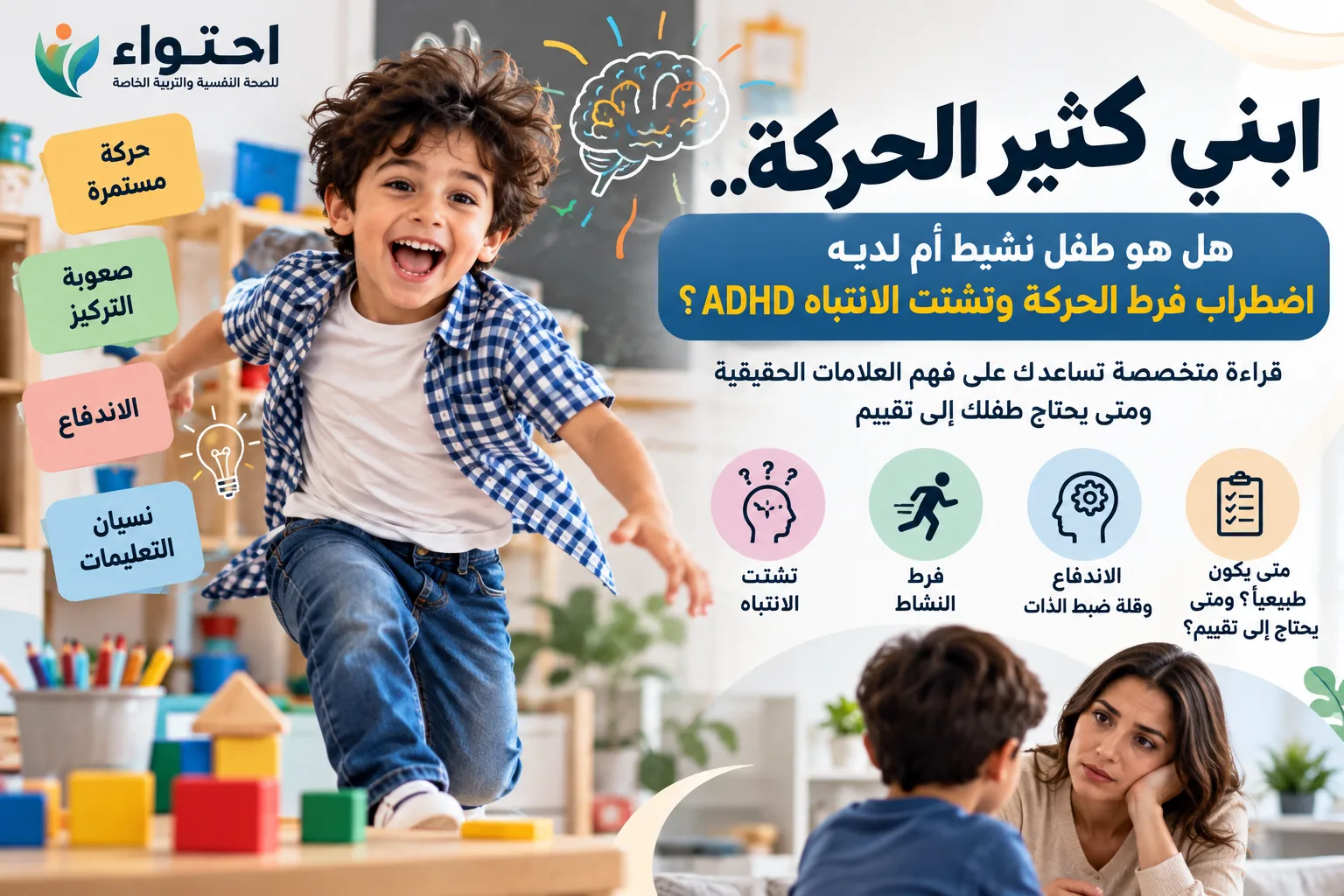
Is My Child Just Active, or Could It Be ADHD?
Prepared by: Dr. Ahmed Mohamed Abdel Wahab
Consultant in Mental Health, Special Education, and Family Counseling
“My child can’t sit still. He is constantly moving and never finishes his homework. Could he have ADHD?”
This is one of the most common questions parents ask when discussing their children’s behavior.
At the same time, a school may describe another child by saying:
“He is intelligent, but extremely distracted. He often forgets his belongings and rarely completes the tasks assigned to him.”
So, does every highly active child have Attention-Deficit/Hyperactivity Disorder (ADHD)?
The short professional answer is: No.
Movement, activity, and impulsiveness—at varying levels—are normal parts of childhood. ADHD cannot be diagnosed simply because a child moves around a lot.
The key question is not:
How much does the child move?
A more accurate question is:
Does the child show a persistent pattern of inattention and/or hyperactivity and impulsivity that clearly interferes with functioning and is inconsistent with what would be expected for the child’s age and developmental level?
This is where a proper assessment begins.
What Is Attention-Deficit/Hyperactivity Disorder?
Attention-Deficit/Hyperactivity Disorder, commonly known as ADHD, is a neurodevelopmental disorder characterized by a persistent pattern of inattention and/or hyperactivity and impulsivity that interferes with functioning or development.
ADHD can present differently from one child to another.
Not every child with ADHD is extremely active.
For some children, the main difficulties involve attention, organization, and completing tasks. For others, hyperactivity and impulsivity are more noticeable. Some children experience significant difficulties in both areas.
My Child Is Very Active—When Is This Normal?
It is natural for children to move, play, and explore their surroundings.
A child may become more active when bored, excited, or placed in an environment that does not adequately meet their need for movement.
For this reason, I prefer not to label a child as “hyperactive” simply because they are energetic.
An important question is:
Can the child regulate their behavior when the situation requires it?
For example, a child may be extremely active during play but still be able to sit, listen, and participate when an activity is engaging and appropriate for their age.
However, when difficulties are persistent and significantly affect learning, relationships, or daily life, a more careful assessment may be necessary.
First Sign: Inattention
One common mistake is reducing ADHD to excessive movement.
In reality, difficulties with attention may be the most significant problem for some children.
Parents or teachers may notice that the child:
- Loses focus easily.
- Has difficulty following instructions.
- Does not complete tasks.
- Frequently forgets homework or personal belongings.
- Has difficulty organizing activities.
- Is easily distracted by surrounding stimuli.
Again, however, the presence of one or two of these behaviors does not necessarily mean that a child has ADHD.
Professionals consider the overall pattern of behavior, its frequency, duration, severity, and impact on everyday functioning.
Second Sign: Hyperactivity
Hyperactivity may appear as constant movement, difficulty remaining seated when expected, running or climbing in situations where it is inappropriate for the child’s age, excessive talking, or a generally high level of physical activity.
However, these behaviors must always be evaluated in relation to the child’s age.
What may be considered normal for a young child can be very different from what is expected from an older child.
Professional assessment should therefore not compare a child with a sibling, classmate, or neighbor’s child.
Instead, we ask:
Is this level of activity consistent with the child’s age and developmental stage?
Third Sign: Impulsivity
Impulsivity may be less obvious to parents than hyperactivity, but it is an important part of assessment.
A child may:
- Act before thinking.
- Frequently interrupt others.
- Have difficulty waiting for their turn.
- Make quick decisions without adequately considering the consequences.
These behaviors can lead to difficulties in the classroom, at home, or during play and social interactions.
It is important to understand that the child may not be deliberately “misbehaving.” Instead, they may be experiencing genuine difficulty with response inhibition and behavioral self-regulation.
The Difference Between an Active Child and a Child Who May Need an ADHD Assessment
I often use one practical principle when speaking with families:
Do not look only at the behavior—look at the impact of the behavior.
Two children may both be highly active.
One may perform well academically, interact successfully with others, and regulate their behavior when the situation requires it.
The other may experience persistent difficulties with learning, frequently lose belongings, fail to complete homework, struggle with peers, and experience ongoing tension within the family.
In such cases, functional impairment becomes a key part of the assessment.
Does the Problem Need to Appear at Home and at School?
This is an extremely important point.
A professional assessment does not usually rely on the observations of only one person or behavior in only one setting.
We need to understand how the child functions across different environments, such as:
- Home.
- School.
- Social activities.
- Other relevant settings.
If the difficulty appears only at school, for example, we need to ask additional questions:
Is there an academic difficulty?
Are the instructions appropriate for the child?
Are there difficulties in the child’s relationship with the teacher or classmates?
Could anxiety be contributing to the behavior?
Could there be a learning difficulty?
Is the classroom environment highly distracting?
The purpose of assessment is not to prove that the child has ADHD.
The purpose is to understand the real reason behind the behavior.
Not Every Attention Problem Is ADHD
This is a principle every parent should understand.
Many factors can make a child appear distracted, restless, or overly active.
These may include sleep problems, anxiety, certain learning difficulties, family stress, hearing or vision problems, and other developmental or psychological conditions.
A good professional assessment therefore does not ask only:
“Does the child show symptoms of ADHD?”
It also asks:
“Could something else explain these symptoms, and are there other difficulties occurring alongside them?”
This is one of the most important differences between a professional assessment and a diagnosis based on a social media video or a quick online test.
“But My Child Can Sit for Hours Playing Video Games”
Some parents say:
“If my child has attention difficulties, how can he concentrate on a game he enjoys for such a long time?”
This is an understandable question, but this observation alone cannot confirm or rule out ADHD.
Attention is not a fixed ability that operates at exactly the same level in every situation.
Motivation, the nature of the task, immediate rewards, level of difficulty, and the presence of distractions can all influence a child’s ability to remain engaged.
Therefore, ADHD should not be diagnosed—or ruled out—simply because a child can watch a movie or remain focused on an electronic game.
Is an Online ADHD Test Enough?
No.
Tests, questionnaires, and rating scales may be useful tools within the assessment process, but they are not substitutes for a comprehensive professional evaluation.
Depending on the child’s individual situation, an assessment may include:
- An interview with the parents or caregivers.
- Developmental, medical, and educational history.
- Information from the school.
- Behavioral observations.
- Appropriate standardized rating scales.
- Assessment of associated academic or developmental difficulties when necessary.
I often emphasize one important principle:
A rating scale supports the professional—it does not replace the professional.
What Should I Do If I Suspect My Child Has ADHD?
The first mistake is ignoring the problem completely.
The second mistake is jumping immediately to a diagnosis.
The more appropriate professional approach is to begin with a structured assessment.
Start by recording the situations in which the difficulties occur.
Ask yourself:
When does the child become distracted?
How long does it last?
What happens immediately before the behavior?
Does it occur both at home and at school?
How does it affect learning?
How does the child respond to instructions?
Are there any sleep problems?
What does the teacher observe?
This information is much more useful to a professional than a general statement such as:
“My child cannot concentrate.”
What Happens After a Diagnosis?
If a qualified professional assessment confirms ADHD, intervention should not become a constant attempt to force the child to “calm down.”
The real goal is to help the child function successfully academically, socially, behaviorally, and in everyday life.
The intervention plan will vary according to the child’s age, symptom severity, individual needs, and any co-occurring difficulties.
Depending on the child, the plan may include:
- Behavioral interventions.
- Parent training.
- School-based strategies.
- Environmental and task modifications.
- Structured routines and organizational support.
- Medical evaluation to discuss additional treatment options when appropriate.
A plan that works for one child may not necessarily be appropriate for another.
What Can Families Do at Home?
Even before the assessment process is completed, several educational and behavioral principles can be useful for many children.
Keep instructions short, clear, and specific.
Instead of saying:
“Go to your room, tidy everything, change your clothes, get your schoolbag, and come back quickly.”
Break the request into smaller steps.
For example:
“Put your schoolbag in its place.”
Once that task is completed, move on to the next instruction.
It can also be helpful to:
- Establish a clear daily routine.
- Reduce distractions during homework.
- Break long tasks into smaller, manageable steps.
- Use positive reinforcement for desired behavior.
Most importantly, do not allow every interaction with the child to become a series of commands and criticisms.
A child who constantly hears:
“Sit down.”
“Pay attention.”
“Stop moving.”
“You are careless.”
“How many times do I have to tell you?”
may gradually begin to develop a negative view of themselves.
Our goal is to change and support behavior—not damage the child’s self-confidence.
The School Is an Essential Partner, Not Just a Source of Complaints
In many cases, teachers have valuable information about the child’s daily functioning.
However, communication between the family and school should not be limited to statements such as:
“Your child disturbed the class today.”
We need more precise observations.
For example:
In which subject does the child become most distracted?
Can the child complete assigned tasks?
How long can the child remain engaged in an activity?
In which situations does the behavior increase?
Which strategies have helped?
The more observable and measurable these descriptions become, the more accurately educational decisions can be made.
A Message to Every Parent
If your child is very active, do not rush to label them as having a disorder.
At the same time, if there are clear and persistent difficulties affecting learning, relationships, and daily functioning, do not postpone assessment for years in the hope that the problem will simply disappear.
From my work in mental health and special education, I always emphasize one principle:
We are not searching for a label to place on the child. We are searching for an explanation that helps us provide the right support.
When a diagnosis is appropriate, it is not the end of the road.
It is a tool for understanding the child’s needs and developing an appropriate intervention plan.
If a family is unsure whether what they are seeing is normal childhood activity or signs that deserve further assessment, an initial consultation with a qualified professional can help organize the available information, determine whether a more comprehensive assessment is needed, and identify the most appropriate next step.
Prepared by:
Dr. Ahmed Mohamed Abdel Wahab
Consultant in Mental Health, Special Education, and Family Counseling
Professional Disclaimer
This article is intended for educational and awareness purposes only and should not be used to diagnose Attention-Deficit/Hyperactivity Disorder (ADHD) or any other condition.
Diagnosis and intervention require assessment by appropriately qualified professionals based on the individual child’s circumstances and the applicable professional and regulatory standards.